
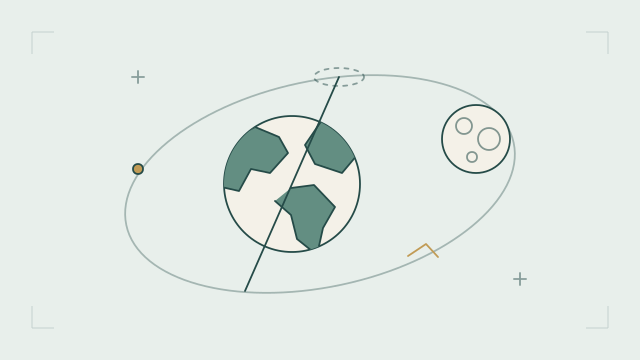
The Moon and Earth's Balance: Why Is Our Natural Satellite So Important?
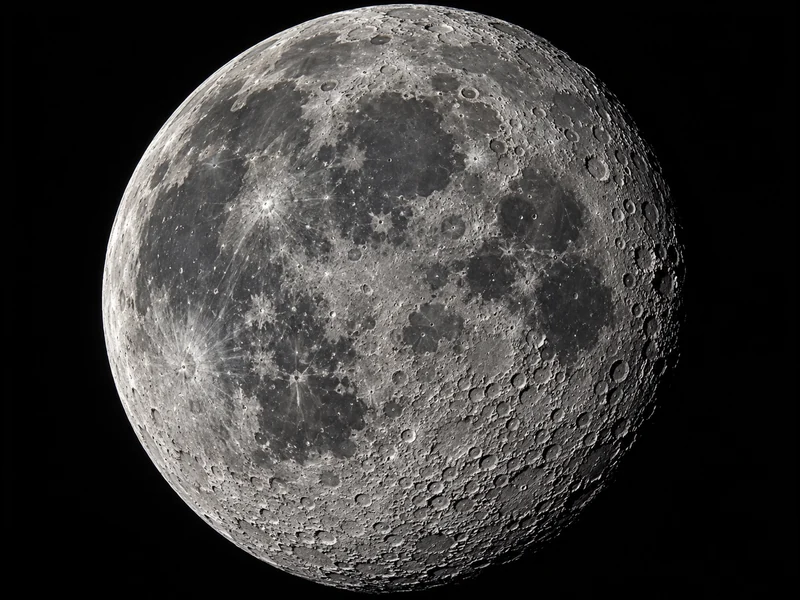
Every night, when the Moon appears in the sky, we gaze upon a silent world, seemingly motionless, covered with thousands of scars. These marks were left by asteroids, comets, and other fragments that have traveled through the Solar System for billions of years. At first glance, we might imagine that our natural satellite absorbed these impacts to protect Earth. But the Moon's true importance is even more surprising. Far beyond illuminating our nights and moving the oceans, it plays a role in a delicate gravitational balance that influences our planet's orientation and, indirectly, the stability of the seasons. To understand this relationship, we must discover why Earth rotates on a slightly tilted axis and imagine what would happen if that axis were lying almost flat in space.
The story begins approximately 4.5 billion years ago, when the Solar System was still a violent environment filled with celestial bodies in the process of formation. According to the leading scientific hypothesis, an object roughly the size of Mars, often called Theia, collided with the young Earth. The impact ejected enormous amounts of material into space, some of which may have eventually come together to form the Moon. The details of this collision remain under investigation, but the idea of an origin involving a giant impact is supported by significant geological evidence and physical simulations. The Moon, therefore, did not simply appear alongside Earth: its very existence may be connected to one of the most extraordinary events in our planet's history.
Since then, Earth and the Moon have shared a long history of encounters with objects arriving from space. However, there is a striking difference between their surfaces. While the Moon preserves craters formed billions of years ago, Earth has relatively few recognizable traces of ancient impacts. This does not mean that our planet was spared. In fact, because Earth is larger and has a stronger gravitational pull, it presents a more favorable target for many objects passing through its vicinity. The secret lies in what happens to the scars. Here, the atmosphere destroys numerous small bodies before they reach the ground, while rain, rivers, wind, volcanic activity, and the movement of tectonic plates continuously reshape the landscape, erasing much of the evidence of past collisions.
On the Moon, the situation is entirely different. Without a significant atmosphere, without rain, and without the geological processes that continually renew Earth's surface, its craters can remain recognizable for billions of years. It is like comparing two books exposed to the passage of time: on Earth, the pages are constantly rewritten; on the Moon, many remain almost intact. Lunar craters therefore serve as an extraordinary natural archive of the Solar System's history. They preserve records of events whose traces have been almost entirely erased from Earth's surface.
But does this mean that the Moon acts as a shield against asteroids? Only to a very limited extent. It can intercept objects, and its gravity can alter certain trajectories, but it can also cause gravitational disturbances that make some collisions more likely. There is no lunar barrier capable of preventing most impacts on Earth. The Moon is not permanently positioned between our planet and the dangerous objects traveling through space. Its heavily cratered surface is therefore not evidence that it absorbed all the blows that would otherwise have struck us. The explanation is simpler and, at the same time, more fascinating: both worlds were hit, but only one preserved much of the evidence.
The Moon's most profound influence on Earth becomes apparent when we stop examining its craters and begin investigating our planet's movements. To understand this phenomenon, imagine a spinning top rotating on a table. Even as it continues spinning, its axis can remain tilted and slowly change direction. Earth also rotates around an imaginary axis passing through the North and South Poles. However, this axis is not perfectly perpendicular to the plane of its orbit around the Sun. It has a tilt of approximately 23.4 degrees, known as axial tilt or obliquity. This seemingly modest angle is directly related to one of the most familiar phenomena of our existence: the seasons.
Contrary to a widespread misconception, summer and winter do not occur primarily because Earth moves closer to or farther from the Sun. They arise because, throughout Earth's annual orbit, the tilt of its axis changes how sunlight is distributed across the hemispheres. When the Northern Hemisphere is tilted toward the Sun, it receives more direct sunlight and experiences longer daylight hours. It is summer in countries such as Canada, while the Southern Hemisphere experiences winter. Approximately six months later, the situation reverses: the Southern Hemisphere receives more favorable sunlight, bringing summer to countries such as Brazil and Australia.
This alternation does not produce the same seasonal patterns across Earth's entire surface. Near the equator, day length and solar exposure vary relatively little throughout the year, and many regions experience seasonal differences more closely associated with rainfall than with temperature. At mid-latitudes, changes in temperature and daylight duration are more pronounced. In polar regions, the axial tilt produces extremes of illumination, including periods when the Sun remains above the horizon for weeks or months and others when it virtually disappears. Our planet, therefore, does not have a uniform climate, but rather a diversity of environments created by the interaction of solar energy, the atmosphere, the oceans, geography, and Earth's axial tilt.
Now imagine that we could change this angle. If Earth rotated with its axis perfectly perpendicular to the orbital plane, with a tilt of zero degrees, seasons caused by axial tilt would virtually disappear. Days would have very similar lengths throughout the year at each latitude, and the Sun would follow an almost unchanging seasonal path across the sky. Equatorial regions would continue receiving intense sunlight, while the poles would remain under extremely oblique illumination. This would not necessarily produce a planet with pleasant, constant temperatures. On the contrary, it could favor persistent climatic contrasts between the equator and polar regions. The absence of traditional seasons would not mean the absence of climatic differences.
But the thought experiment becomes far more remarkable when we imagine the opposite extreme. What if Earth were tilted by 90 degrees? In this scenario, its rotation axis would lie almost flat in the orbital plane. During one part of the year, the North Pole would point directly toward the Sun. Six months later, it would be the South Pole's turn. At the height of polar summer, sunlight could strike one of the poles almost perpendicularly, a situation radically different from what we experience today. Each pole would receive approximately six consecutive months of sunlight followed by another six months of darkness.
This would not mean that one side of Earth would remain permanently illuminated while the other was plunged into endless night. Our planet would continue rotating and traveling along its orbit around the Sun. What would change profoundly is the distribution of sunlight throughout the year. Regions currently associated with polar cold would receive extraordinary amounts of solar energy during certain periods, while others would experience prolonged darkness. The climatic consequences would also depend on atmospheric circulation, the oceans, clouds, and the surface's ability to store and reflect energy. We could not simply conclude that the entire Earth would freeze or become uninhabitable, but it would be a world with seasonal patterns profoundly different from those we know today.
What makes this even more interesting is that we do not have to leave the Solar System to find an example of a planet that is almost lying on its side. Uranus, the seventh planet from the Sun, has an axial tilt of approximately 97.8 degrees. In other words, it rotates practically sideways as it travels along its orbit. One complete revolution around the Sun takes about 84 Earth years. Consequently, each of its seasons lasts approximately 21 years, and its polar regions can remain under continuous sunlight or darkness for roughly four decades. During part of its orbit, one of its poles points almost directly toward the Sun. The origin of this extreme tilt is still being investigated, and major collisions during the planet's formation are among the proposed explanations.
Faced with this example, an inevitable question arises: why does Earth not have a tilt similar to that of Uranus? This is where the Moon's presence takes on extraordinary importance. Lunar gravity exerts forces on Earth that, combined with the Sun's influence, contribute to the slow change in the orientation of our planet's rotation axis, a movement known as precession. This phenomenon can be compared to the circular motion traced by the axis of a tilted spinning top. The Moon alters the dynamics of this precession and helps prevent certain gravitational resonances, situations in which different periodic motions can interact and amplify oscillations. In this way, it contributes to keeping Earth's axial tilt within a relatively limited range.
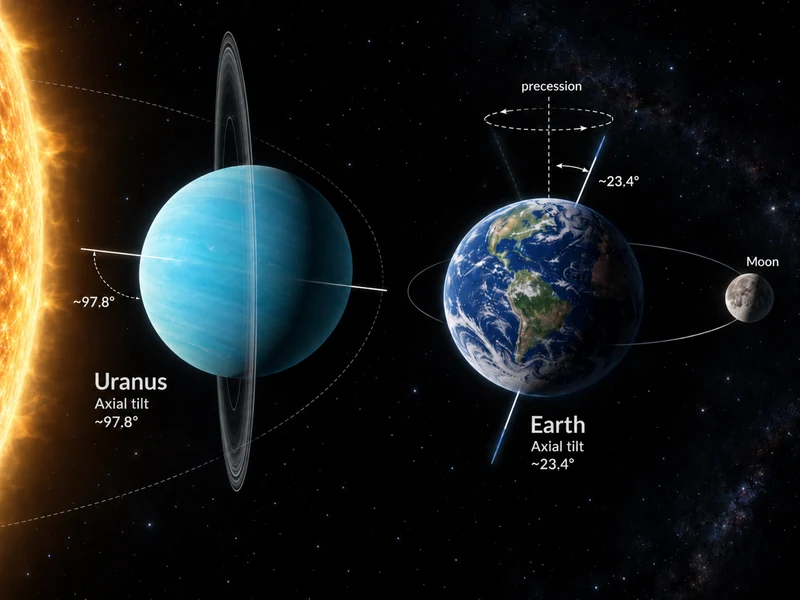
This stability is not absolute. Earth's axial tilt itself varies naturally over time. During approximately the past million years, it has oscillated between about 22.1 and 24.5 degrees, following a cycle of roughly 41,000 years. These variations are part of the so-called Milankovitch cycles, which describe slow changes in Earth's orbital geometry and orientation. By altering the distribution of solar energy, these cycles help explain major long-term climatic changes, including the advance and retreat of vast ice sheets. The Moon does not eliminate these changes, but it is part of the gravitational system that influences the evolution of our planet's orientation.
The possibility of an Earth without the Moon has become the subject of significant scientific research. In 1993, a study published in the journal Nature showed that, without lunar influence, certain configurations of Earth's dynamics could allow much larger chaotic variations in axial tilt, potentially reaching extreme values over geological timescales. However, later studies, including research published in 2012 in the journal Icarus, demonstrated that a hypothetical Earth without the Moon would not necessarily experience all these variations. Depending on the initial conditions and the evolution of the planetary system, its axial tilt could remain relatively limited for hundreds of millions of years. The scientific conclusion therefore requires caution: the Moon contributes to Earth's current stability, but we cannot claim that its absence would inevitably turn our planet into a second Uranus.
The Moon's influence is also visibly expressed in the oceans. Its gravitational attraction is the primary contributor to the forces that produce tides, although the Sun also plays a role in this process. The periodic movement of water transforms coastal environments, influences ecosystems, and contributes to ocean mixing processes. Over billions of years, the gravitational interaction between Earth and the Moon has also altered our planet's rotation. Some of the energy associated with tides is dissipated, contributing to the gradual lengthening of Earth's days and the Moon's slow recession, currently measured at approximately 3.8 centimeters per year. Even though they are separated by an average distance of about 384,000 kilometers, the two bodies continue to profoundly influence each other's movements.
It is tempting to imagine that this combination of events was carefully arranged to make our existence possible. After all, a gigantic collision may have given rise to the Moon; its presence subsequently influenced Earth's oceans and orientation; and over billions of years, our planet developed environments capable of supporting an extraordinary diversity of life forms. However, science does not demonstrate that the Moon was indispensable to the emergence of life, nor that planets without large natural satellites are necessarily uninhabitable. What we do know is that Earth's physical history has been profoundly influenced by its celestial companion.
The next time we look at the Moon, perhaps we will see it differently. That luminous disk, seemingly motionless in the sky, is a world marked by ancient collisions and connected to Earth through a gravitational interaction spanning billions of years. As we contemplate its craters, the seasons continue to change, the oceans respond to its gravitational pull, and our planet rotates on its subtly tilted axis. Between the events that may have shaped its origin and the gravitational influence it continues to exert on Earth, the Moon reminds us of an extraordinary truth: some of the most familiar conditions of our existence depend on cosmic events whose magnitude exceeds anything we can directly experience. And perhaps this is one of astronomy's greatest wonders: discovering that even the arrival of spring is part of a story written far beyond Earth.
Author's Note
This article presents an interpretation based on established knowledge from astronomy, physics, and planetary science, supplemented by hypotheses and findings from academic research. Scenarios involving an Earth without the Moon or with an extreme axial tilt are hypothetical thought experiments used to explain physical principles, not predictions of future events. The concluding reflections represent the author's interpretation and should not be confused with scientific conclusions.
Scientific References: NASA — Moon Formation. Formation of the Moon; NASA — Why Does the Moon Have Craters? Lunar craters and their preservation; NASA — Milankovitch (Orbital) Cycles and Their Role in Earth's Climate. Axial tilt and long-term climate variations; NASA — Uranus Facts. Uranus's orbital characteristics and axial tilt; Laskar, J., Joutel, F., & Robutel, P. (1993). Stabilization of the Earth's obliquity by the Moon. Nature, 361, 615–617; Lissauer, J. J., Barnes, J. W., & Chambers, J. E. (2012). Obliquity variations of a moonless Earth. Icarus, 217(1), 77–87; NOAA — Tides and Water Levels. Lunar and solar gravitational effects on Earth's tides.
© 2026 AIhumanbooks. All rights reserved.