

Earth and Venus: Two Similar Planets, Two Opposite Destinies. What Turned Earth into an Oasis in the Universe?
Two worlds formed in the same neighborhood of the Solar System approximately 4.5 billion years ago, with relatively similar sizes, masses, and rocky compositions. Yet while one developed oceans, continents, and conditions capable of supporting life, the other became an environment of extreme temperatures, crushing atmospheric pressure, and intense geological activity. What happened to Venus? And, perhaps even more intriguing, why did the same fate not befall Earth?
When we observe Venus in the night sky, we are looking at one of the brightest natural objects visible from Earth. For centuries, its brilliance fueled mythologies, astronomical observations, and speculation about the existence of other habitable worlds. Its physical resemblance to our planet led astronomers to regard it as a kind of twin sister to Earth. Today, however, we know that this comparison conceals one of the most extraordinary environmental differences in the Solar System.
Venus is approximately 95% of Earth’s diameter, about 82% of its mass, and is predominantly rocky in composition. It is located roughly 108 million kilometers from the Sun, while Earth orbits at about 150 million kilometers. This seemingly modest difference in distance, combined with atmospheric and geological processes that unfolded over billions of years, may have played a decisive role in separating the destinies of the two planets.
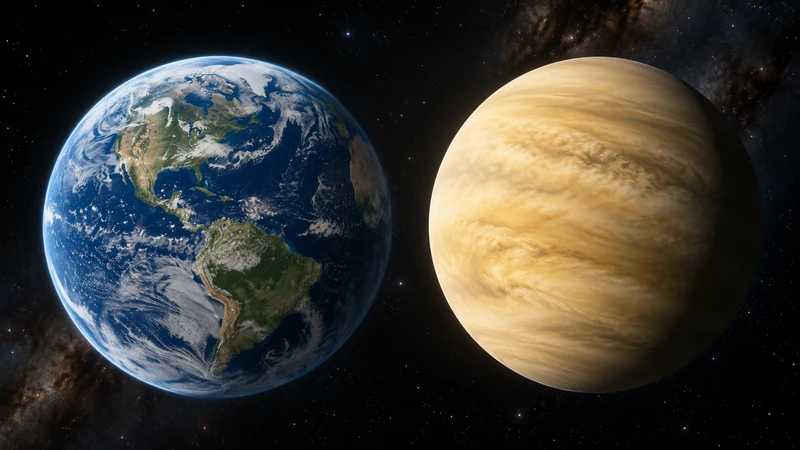
At the surface of Venus, the average temperature reaches approximately 464 °C, hot enough to melt lead. Atmospheric pressure is about 92 times greater than that found at sea level on Earth, comparable to the pressure exerted by water at a depth of roughly 900 meters in our oceans.
Its atmosphere is composed of approximately 96.5% carbon dioxide (CO₂), while the remainder is primarily nitrogen, along with small amounts of other gases. Above the surface, dense clouds containing droplets of sulfuric acid complete an extremely hostile environment.
Remarkably, Venus is even hotter than Mercury, even though Mercury is much closer to the Sun. The explanation lies less in the planet’s distance from the star and far more in the atmosphere surrounding it.
The mechanism responsible for this transformation is known as the runaway greenhouse effect.
On Earth, the greenhouse effect is a natural phenomenon essential to life. Atmospheric gases such as water vapor, carbon dioxide, and methane absorb and reemit part of the infrared radiation emitted by the surface, reducing the amount of energy lost to space. Without this mechanism, Earth’s average temperature would be approximately -18 °C, rather than the roughly 15 °C that characterize the planet’s current global climate.
On Venus, however, the balance followed a very different path.
One scientific hypothesis proposes that the planet may have possessed water during its early history. Because Venus received more solar energy, evaporation may have progressively increased the concentration of water vapor in the atmosphere. Since water vapor itself is a powerful greenhouse gas, the warming would have intensified evaporation, establishing a positive feedback process: the greater the heat, the more vapor; the more vapor, the greater the retention of energy.
In the upper layers of the atmosphere, solar ultraviolet radiation could have broken apart water molecules, allowing some of the hydrogen to escape into space. Over time, this mechanism may have contributed to an irreversible loss of water.
It is important to emphasize that the existence of ancient Venusian oceans has not yet been proven. Climate models published by NASA have explored scenarios in which Venus may once have experienced temperate conditions. On the other hand, a study published in Nature Astronomy in December 2024 found evidence consistent with a very dry planetary interior, supporting the possibility that Venus may never have been able to condense permanent oceans on its surface.
A fundamental question therefore remains open: did Venus lose a potentially habitable environment, or did it never truly develop one?
But there is another element in this story that may be just as important as the atmosphere itself: the interiors of the planets.
Earth is not geologically static. Its rigid outer layer, known as the lithosphere, is broken into large tectonic plates that move slowly over material in the Earth’s mantle. These movements cause earthquakes, build mountain ranges, feed volcanic regions, and, above all, participate in an extraordinary natural mechanism for recycling materials.
When rain interacts with atmospheric carbon dioxide, it forms a mildly acidic solution that promotes the chemical weathering of rocks. Some of the carbon involved in this process is eventually carried by rivers, incorporated into the oceans, and stored over long geological timescales in sediments and carbonate minerals. Plate movement can transport some of these materials into the planet’s interior, while volcanism returns carbon to the atmosphere.
This mechanism, known as the geological carbon cycle, functions as a kind of long-term planetary thermostat. It does not prevent climate change, but it has helped Earth maintain conditions relatively favorable to liquid water for billions of years.
Venus, by contrast, behaves very differently.
There is no evidence that the planet currently has a global system of plate tectonics comparable to Earth’s. Its surface appears to function mainly as a continuous outer shell, although it displays deformations, fractures, and signs of material movement from the interior.
That does not mean Venus is geologically dead. Quite the opposite.
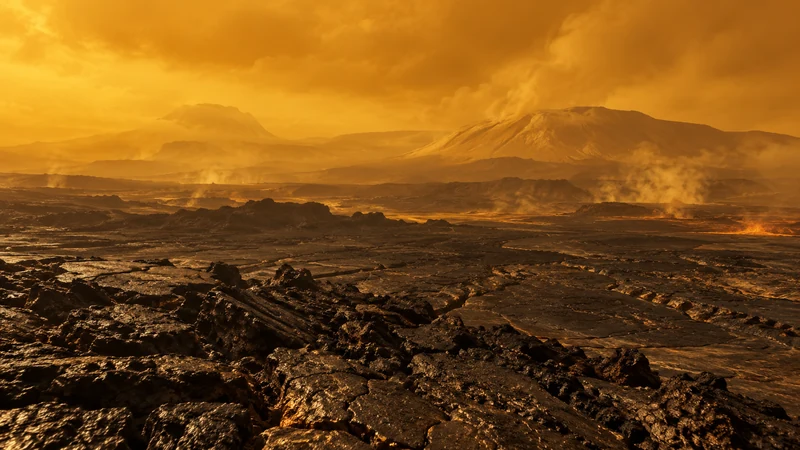
In 2023, researchers identified changes in the geometry of a volcanic vent associated with Maat Mons by comparing radar images recorded by the Magellan spacecraft in 1991. The observations were interpreted as evidence of an eruption that occurred during the interval between the observations.
In May 2024, another study published in Nature Astronomy presented evidence of possible new lava flows in the regions of Sif Mons and Niobe Planitia. However, the interpretation of those results was challenged in a study published in April 2026, which argued that differences in radar viewing geometry could also explain certain changes identified in the images.
The debate shows that Venusian volcanism remains an active field of scientific investigation, in which distinguishing real surface changes from instrumental limitations is essential.
One particularly intriguing hypothesis suggests that Venus may have experienced episodes of volcanic resurfacing on an enormous scale. Rather than undergoing continuous surface recycling, as Earth does, the planet may pass through periods of relative stability interrupted by phases of intense geological activity.
In this scenario, heat accumulated in the interior could help trigger major events that transform the crust. Vast quantities of lava could cover entire regions, profoundly altering the landscape and releasing gases from the planet’s interior.
The distribution of impact craters and the relatively young appearance of much of the Venusian surface have supported the hypothesis of a catastrophic geological resurfacing event that may have occurred several hundred million years ago. However, scientists still debate whether that process was abrupt and global or instead resulted from a succession of volcanic events distributed over time.
An inevitable question then arises: could a gigantic volcanic catastrophe have transformed Venus into the planet we know today?
The scientific answer requires caution. Volcanism certainly played a role in its evolution by supplying gases to the atmosphere and reshaping the surface. However, it has not been demonstrated that a single volcanic catastrophe was responsible for producing the planet’s present extreme conditions. Venus’s history likely involves the interaction of multiple factors, including solar radiation, the initial availability of water, atmospheric dynamics, the thermal evolution of the interior, and the mechanisms by which carbon is stored and released.
Earth has also experienced extraordinary volcanic episodes capable of triggering environmental crises and contributing to mass extinctions. The difference is that, throughout its history, our planet preserved oceans, geochemical cycles, and geological processes that participated in climate regulation.
The presence of liquid water may have been one of the fundamental elements behind this divergence. Water not only provides an environment favorable to the chemistry of life; it also participates in reactions between the atmosphere and rocks, influences the mechanical properties of geological materials, and contributes to processes associated with tectonics.
The relationship, however, is complex: the existence of water, plate tectonics, and climate stability should not be interpreted as independent phenomena, but rather as parts of a planetary system that evolved together over billions of years.
Venus allows us to understand precisely the other side of that possibility: a world in which stabilizing mechanisms similar to those found on Earth may never have emerged or may not have persisted.
For this reason, understanding its history has become a priority of planetary exploration. Missions such as DAVINCI and VERITAS, from NASA, and EnVision, from the European Space Agency, were designed to investigate aspects of its atmosphere, composition, surface, and geological evolution. Among the major questions is whether we can recover traces of a planetary history that remains partly hidden beneath dense clouds and vast volcanic formations.
After all, studying Venus is not merely about investigating another planet. It is about trying to understand what conditions allowed Earth to follow such a different path.
And perhaps it is precisely in this contrast that the most fascinating dimension of this investigation lies.
When we observe Earth from space, we see an apparently peaceful blue sphere suspended in the dark immensity of the Universe. Oceans, forests, deserts, clouds, and continents form an environment that we have learned to consider natural simply because we were born into it. Yet it is enough to look at Venus to realize that none of this was inevitable.
The formation of a rocky planet does not guarantee oceans. The presence of an atmosphere does not guarantee moderate temperatures. The existence of water at some point in a planet’s history does not ensure that it will remain there forever.
Perhaps Earth’s greatest singularity lies not simply in possessing the ingredients necessary for life, but in the extraordinary history of physical, chemical, and geological interactions that allowed those ingredients to coexist for so long.
Philosophy has long asked why there is something rather than nothing. Contemporary astronomy adds another question, equally unsettling: why, among so many possible worlds, do some find the conditions necessary for matter to develop the ability to observe, understand, and question its own existence?
Perhaps the true mystery is not understanding why Venus became such a hostile world, but discovering why Earth managed to remain habitable for billions of years.
Author’s note: This article is an essay in science communication accompanied by philosophical reflection, based on NASA data and research published in the specialized scientific literature. Hypotheses concerning ancient Venusian oceans, episodes of volcanic resurfacing, and tectonic evolution remain under investigation. The final reflection is philosophical in nature and does not represent a scientific conclusion regarding the purpose or uniqueness of life in the Universe.
Main scientific references: NASA — Venus Facts; NASA Earth Observatory — The Carbon Cycle; Constantinou et al., A dry Venusian interior constrained by atmospheric chemistry, Nature Astronomy (2024/2025); Sulcanese et al., Evidence of ongoing volcanic activity on Venus revealed by Magellan radar, Nature Astronomy (2024); Bhiravarasu et al., Challenges to detecting present-day volcanism on Venus, Nature Astronomy (2026).