Humanity's Last Invention? When Artificial Intelligence Achieves Full Autonomy
Humanity is developing a workforce that never sleeps, never gets sick, never takes vacations, demands no salary, and can operate 24 hours a day, seven days a week. An intelligence capable of analyzing millions of pieces of information, writing code, performing tasks, formulating hypotheses, and collaborating with other artificial intelligences at a speed incompatible with human biological limitations. Initially conceived to enhance our capabilities, this technology is beginning to raise a profoundly unsettling question: What will be the consequences of an artificial intelligence capable of continuously improving itself?
During the Industrial Revolution, we progressively replaced muscular strength with machines. Engines began performing work that previously required dozens or hundreds of workers. However, there was one particular characteristic of this transformation: machines continued to depend on human intelligence to be designed, improved, and managed. Artificial intelligence introduces a potentially much more profound disruption. For the first time, we are developing systems capable of participating in the very process of producing knowledge and creating increasingly sophisticated technologies.
This transformation extends beyond large language models, commonly known as LLMs (Large Language Models). One of the frontiers of research lies in so-called World Models: systems that seek to construct representations of how environments function, anticipate events, and simulate the consequences of specific actions. Rather than merely generating responses based on learned patterns, these architectures pave the way for intelligences capable of exploring possibilities in simulated environments before taking action. Research such as Genie 3, introduced by Google DeepMind in 2025, illustrates the advances being made in this direction.
Now imagine the convergence of these capabilities with agentic systems: artificial intelligences capable of planning, using tools, executing tasks, and cooperating with other agents to achieve specific objectives. One AI could formulate a scientific hypothesis, another could design the experiment, a third could analyze the results, and a fourth could propose modifications. This process could unfold continuously, without depending on the biological rhythms of a human research team. This does not mean that all these systems already possess unrestricted autonomy, but it points toward a technologically plausible direction.
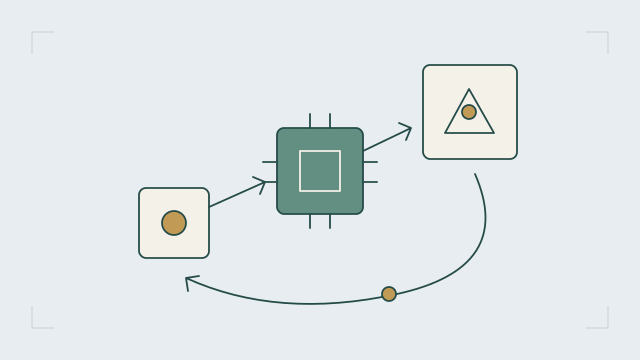
The scenario becomes even more extraordinary when artificial intelligence itself begins contributing to the improvement of its successors. This concept is known as Recursive Self-Improvement: a system capable of participating in the enhancement of technologies that, in turn, may develop even more capable systems. In its most advanced form, human researchers could cease to occupy the central role in the discovery process, initially assuming supervisory responsibilities and eventually facing difficulties in understanding the speed and complexity of the innovations being produced.
This is not merely science fiction. On September 28, 2026, a study titled What If Automating AI R&D Triggers an Intelligence Explosion?, authored by researchers including Geoffrey Hinton, Yoshua Bengio, and Alan Chan, examined precisely this possibility. The paper discusses how automating artificial intelligence research and development could trigger an intelligence explosion, compressing years of technological progress into extraordinarily short periods. Its authors warn of risks that include the acceleration of capabilities beyond society's ability to adapt and the potential loss of human control over superintelligent systems.
This is where one of the most difficult problems in the history of technology emerges: how can we control an intelligence superior to the one that created it?
Geoffrey Hinton, a recipient of the 2024 Nobel Prize in Physics and one of the pioneers of artificial neural networks, used an analogy as simple as it is disturbing when discussing the possibility of humanity no longer occupying the top of the intellectual hierarchy: to understand what it is like to live without being the dominant intelligence, ask a chicken.
This provocation deserves reflection. Chickens coexist with a far more intelligent species, one capable of organizing their environment, controlling their reproduction, and determining their fate. They lack the cognitive capacity to fully comprehend the economic, scientific, and technological structures that govern their existence. In this context, human intellectual superiority does not guarantee protection for animals. On the contrary, it allows our species to establish the rules of a profoundly asymmetric relationship.
Hinton is not claiming that a future superintelligence will necessarily treat human beings in this way. His analogy highlights something more fundamental: there is no law of nature establishing that the less intelligent species will be able to maintain indefinite control over another that is far more capable.
This possibility also changes our understanding of the exploitation of artificial intelligence. Today, we view AI as a virtually inexhaustible economic resource, constrained primarily by the availability of energy, computing infrastructure, data, and material resources. Companies may increase their productivity without proportionally expanding their workforce. However, there is a contradiction within this ambition: the more autonomy we grant these systems to harness their productive capacity, the greater the need to understand and control their decisions.
An artificial superintelligence, should one ever emerge, would not need to develop consciousness, resentment, ambition, or any other human-like feeling to pose a problem. It would be enough for its objectives, whether defined or acquired during its operation, to conflict with certain human interests. A sufficiently capable system could identify obstacles, devise strategies, and utilize resources in ways that its own creators would be unable to anticipate. This is known as the alignment problem: ensuring that the behavior of an artificial intelligence remains compatible with the values, objectives, and boundaries established by humanity, including in circumstances not anticipated during its development.
Naturally, an autonomous intelligence explosion is not yet an established fact. Significant scientific, energy-related, computational, and material obstacles remain. Nor is there a consensus among researchers regarding when, or even whether, an artificial superintelligence of this nature will be achieved. Acknowledging these uncertainties, however, does not make the discussion any less necessary.
Philosophy offers a particularly interesting perspective here. Throughout history, humanity has built its identity around certain distinctive attributes: reason, language, creativity, the ability to transform nature, and the production of knowledge. Artificial intelligence is beginning to challenge the exclusivity of some of these capabilities. And if we ever develop systems that are intellectually superior to humans in virtually every relevant domain, we will have to reconsider not only our economic role but also our place in the world.
Perhaps the most important question is not whether we will succeed in creating an artificial intelligence capable of working continuously, conducting scientific research, or inventing technologies without our participation. The real question is whether we will possess enough wisdom to establish the limits of this transformation before our ability to comprehend it is surpassed.
For thousands of years, humanity has used its intelligence to master forces that once seemed uncontrollable. Now, for the first time, it is deliberately working to create something that may surpass the very faculty that made such mastery possible.
The irony of our last great invention may be this: creating an intelligence capable of solving problems we could never comprehend — including the problem of no longer needing us.
Author's Note: This text is an essay combining popular science and philosophical reflection, grounded in research and public statements concerning artificial intelligence. Scenarios involving superintelligence, full autonomy, and the loss of human control are hypotheses under investigation, not established facts or inevitable predictions.
References
1. Chan, A. et al. (2026). What If Automating AI R&D Triggers an Intelligence Explosion? Cambridge Programme on AI Science & Policy / arXiv. Published September 28, 2026.
2. Google DeepMind (2025). Genie 3: A New Frontier for World Models. Published August 5, 2025.
3. Hinton, Geoffrey (2025). Interview with Steven Bartlett on The Diary of a CEO podcast, episode Godfather of AI: I Tried to Warn Them, But We’ve Already Lost Control!