The Freedom of Consciousness in the Face of Reality
There is a human experience that is both universal and profoundly solitary: the confrontation with a reality that refuses to yield to our desires. At some point in life, we all encounter the feeling that the world should be different from what it is. This friction between the imagined life and the life actually lived can arise in the form of irreparable loss or the collapse of a life structure, but it manifests just as frequently in the subtle frictions of everyday life. It is the professional frustration that drags on over time, the aging that transforms the body, the meticulously drawn plan that crumbles in the face of the unforeseen, or the acute perception that certain past choices can no longer be undone. Faced with this disconnect, the primary human instinct is action: we want to intervene, fix, shape the environment, and force circumstances to align with our expectations. However, the very structure of existence imposes severe limits on our will. There are realities that are, at least in the present moment, immutable, inescapable, or simply beyond our reach.
When reality presents itself as a massive block that we cannot alter, an unavoidable philosophical question arises: what exactly remains within our power? If the transformation of the external world is momentarily or definitively denied to us, where does our freedom lie? The philosophical tradition of classical Stoicism, developed by thinkers such as Epictetus, Seneca, and Marcus Aurelius, offers an answer that challenges our common sense. For the Stoics, human suffering does not derive primarily from the facts themselves, but from the narrative we construct about those facts. The foundation of this philosophy rests on the rigorous distinction between what is within our control and what escapes our dominion. Health, reputation, the actions of others, and the reversals of fortune belong to the realm of the uncontrollable. However, our opinions, our impulses, and, above all, our judgments about what happens to us remain entirely under our jurisdiction.
The Stoic proposition, therefore, is not an invitation to apathy, but a strategic reallocation of energy. When Epictetus suggests that it is not things that disturb us, but the judgments we make about them, he is pointing to an intimate mechanism of consciousness. The pain of loss or the anguish of uncertainty do not inhabit the raw event, but are born in the encounter between the event and our evaluation of it. To modify our perspective does not mean pretending that the obstacle does not exist, nor does it mean artificially celebrating adversity. Rather, it means stripping the event of the excess weight that our mind projects onto it. It is the ability to look at a dismissal, the end of a relationship, or an illness, and separate the fact itself from the imagined catastrophe that our anxiety builds around the fact.
This ancient intuition finds deep resonance in contemporary philosophy of mind, which teaches us that human perception is never a passive copy or an exact mirror of the external world. The brain does not merely record sensory data like a camera; the mind continuously and actively filters, organizes, interprets, and assigns meaning to experience. In cognitive psychology and the philosophy of mind, it is common to speak of cognitive appraisal—a concept that refers to the way the mind judges an event and bestows significance upon it, thereby determining our emotional reaction to it. We do not experience reality in a raw state, but always through the mediation of mental models—the internal structures, forged by our history, culture, and language, with which we navigate the world.
For this reason, two people can go through incredibly similar external circumstances and yet experience them in diametrically opposed ways. What for one individual is the paralyzing end of a career, for another may be interpreted as a necessary, albeit painful, break toward something new. This divergence does not occur because one of them is deluded about the objective facts, but because their values, their memories, and their belief systems actively shape the texture of their experience. Reality does not change, but the mental landscape in which reality is received determines the magnitude of its impact.
However, when investigating the power of interpretation, rigorous care must be taken not to fall into the trap of believing that materiality does not matter. The external world exists, resists, and carries weight. The idea that we experience reality through our consciousness is not a claim that reality is imaginary or irrelevant. To understand this subtlety, the tradition of phenomenology is of immense value. Phenomenology is the philosophical study of experience as it presents itself to consciousness. One of its central concepts is intentionality, which describes the fundamental property of the mind to always be directed toward something. Consciousness is never an empty space; it is always consciousness of something—of an object, of a memory, of a fear, of a possibility. Thus, when we look at reality, our consciousness is already oriented by intentions, projecting meanings onto what it perceives. The world and consciousness are not isolated entities, but are intrinsically intertwined.
It is at this point of intersection between the individual and the world that existentialist philosophy adds a vital dimension to the debate. While Stoicism often seeks inner serenity through the control of judgments, existentialism—through figures like Jean-Paul Sartre, Albert Camus, Simone de Beauvoir, and Viktor Frankl—emphasizes responsibility, the anguish of freedom, and the creation of meaning. For existentialists, human beings are responsible for what they do with what has been done to them. Even when we are thrown into situations we did not choose, the inalienable obligation to respond to those situations remains. The attitude we take in the face of adversity is, in itself, a choice that defines our essence. Frankl, observing human behavior under the most extreme conditions of deprivation imaginable, concluded that while everything can be taken from a human being, the last of human freedoms remains: to choose one's attitude in any given set of circumstances.
The distinction between Stoicism and existentialism is subtle, but profound. The Stoic asks how to align their will with unavoidable reality so as not to suffer unnecessarily, while the existentialist asks what meaning they can create and what action they can take based on the condition imposed upon them. Despite their differences, both traditions converge in recognizing that the space between what happens to us and our response to that event is the true territory of moral autonomy. Modifying one's perspective, under this combined light, is not an act of passive submission. On the contrary, it is an active exercise of lucidity and intellectual courage.
Nevertheless, philosophy cannot and should not be used as an instrument of alienation or a justification for complacency. It is here that we establish an impassable ethical limit: a change in perspective does not have the power to erase concrete oppression. Poverty, serious illness, grief, structural violence, and social injustice are not mere problems of subjective interpretation. To tell someone suffering under the weight of degrading material conditions that they simply need to change their mindset is not philosophy; it is a form of cruelty that blames the individual for suffering they did not choose. True philosophical reflection acknowledges the real fractures of the world. It helps us identify which part of our experience can still be reframed, without ever exempting us from the ethical duty to resist injustice and fight for the transformation of objective conditions.
Dissatisfaction with life frequently contains two distinct elements that are often entangled: the external situation itself and the internal interpretation we make of it. There are moments when the appropriate response demands indignation and action to change the world. In many other moments, however, change is impossible, the timeline for resolution is uncertain, or the driving force of circumstances is far beyond our reach. In those instants, the freedom that remains to us is to question our own interpretation. To reconsider the meaning we give to an event is not to falsify reality, but to honestly examine our dashed expectations, distinguishing the bare facts from the horror stories we tell ourselves. If I cannot change the fact that a project failed, I can alter the narrative that equates this failure to a character flaw. If I cannot force the permanence of what is ephemeral, I can alter my perception of what it means to lose and move forward.
This balance between the acceptance of the immutable and the responsibility for one's own attitude marks the transition to true existential maturity. To mature is not to lose the capacity to feel sadness, nor is it to cynically resign oneself to a defective world. To mature, in the philosophical sense, is perhaps to learn to inhabit the constant tension between the world as it is and the world as our consciousness experiences it. It is to develop the wisdom not to demand that reality bend to every one of our plans, while preserving the strength not to let reality spiritually crush us when those plans fail.
Life continually invites us to an investigation into the limits of our power. Amidst uncertainties and imperfections, the deepest challenge is learning to formulate two fundamentally different questions in the face of difficulties. The first is: 'What, in this reality, should I try to change?' The second, no less essential, is: 'What, in my way of seeing this reality, do I need to reconsider?' These questions are not a static formula, but compasses for navigating the real. In the end, we realize that freedom rarely begins with total control over the world around us. Almost always, it is born and consolidated in that tiny, subtle, and irreplaceable space that exists between what happens to us and the meaning we choose to give to everything that happens.
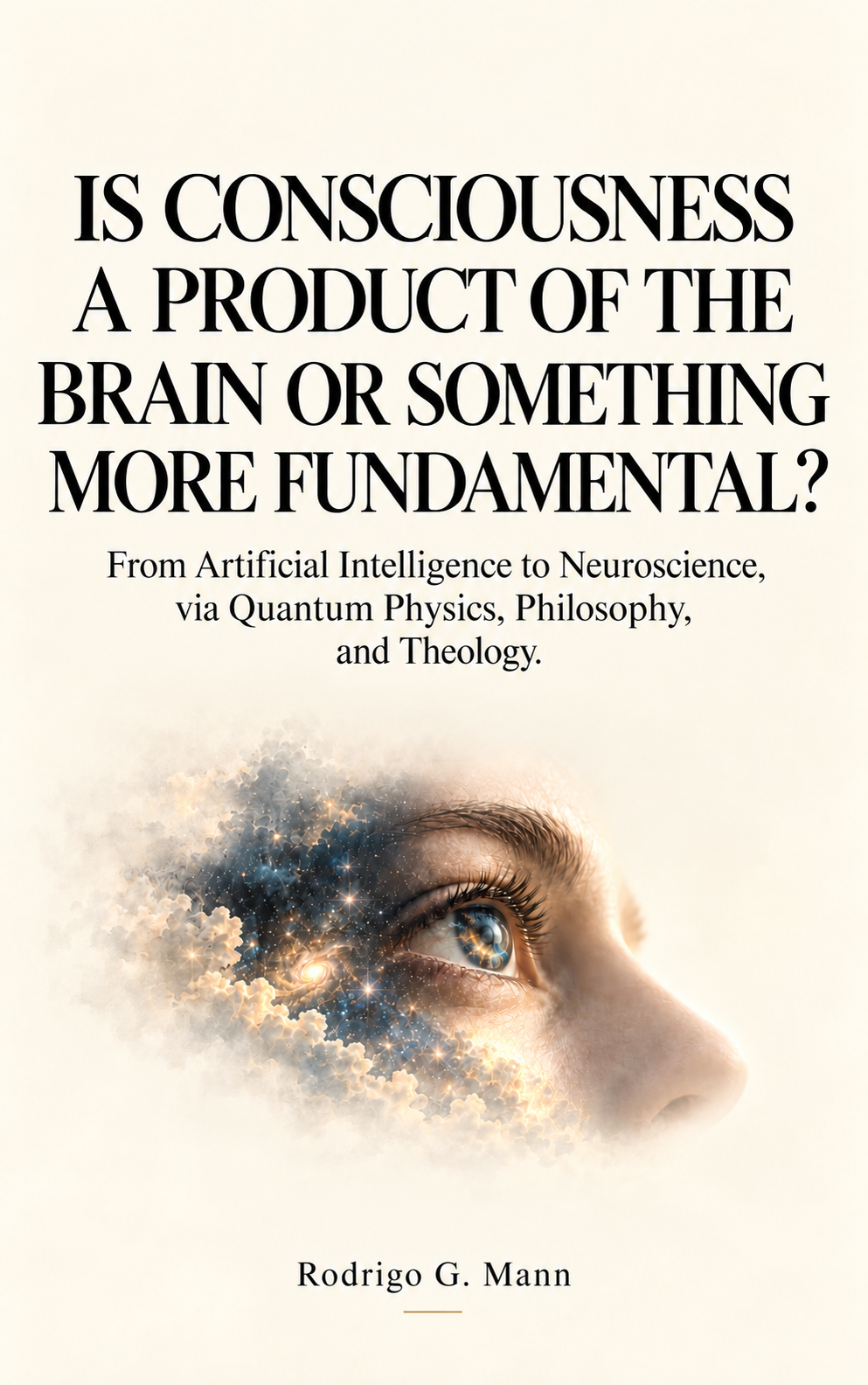
This essay by R. Sc. Mann integrates his reflections on consciousness, Stoicism, and human autonomy in the face of objective reality.
An investigation into the limits of action and the space for interpretive freedom in human experience.
© aihumanbooks