Could Reality Be Trapped in a Loop? Nietzsche’s Eternal Recurrence
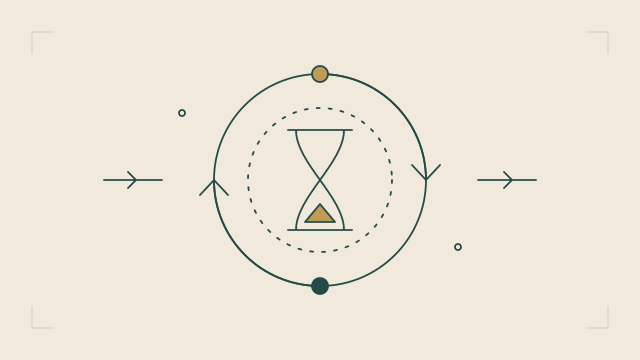
Imagine your life starting over, from exactly the same beginning. You would be born in the same house, meet the same people, make the exact same mistakes, and achieve the same victories. And at some point in the future, with no memory of having done so before, you would read these very words again. Could reality itself be trapped in an infinite loop?
Although it sounds like the plot of a work of fiction, this question has intrigued intellectuals for more than a century. The Prussian philosopher Friedrich Nietzsche called this idea "eternal recurrence," a concept he continued to reflect on until the end of his life. It is not a proven mathematical thesis, but rather a nineteenth-century philosophical intuition that resonates today with some of the deepest investigations in cosmology and physics.
Born in 1844, Nietzsche became a professor of philology in Basel at a remarkably young age, resigning from his position in 1879 for health reasons. It was during a walk near Lake Silvaplana in Switzerland, in August 1881, that the idea of eternal recurrence struck him like a revelation. The concept was discreetly introduced in aphorism 341 of The Gay Science (1882) and further developed in his landmark work Thus Spoke Zarathustra (1883–1885). In the philosopher's vision, a mysterious visitor would announce that your life, with every pain, joy, and breath, would repeat countless times, in exactly the same order.
For Nietzsche, eternal recurrence served as the ultimate existential test. In a Europe where many no longer perceived any greater meaning in life—a void he diagnosed as nihilism—the hypothesis emerged as a brutal and transformative challenge. If you had to live everything again, would you accept it? Those who can answer this provocation affirmatively achieve what he called amor fati, the love of fate: willing life as it is, fully embracing responsibility for one's own choices. Because this demands such responsibility for one's existence, Nietzsche is often regarded as one of the precursors of existentialism, influencing twentieth-century thinkers such as Jean-Paul Sartre and Albert Camus.
Yet this provocation concerning the nature of time extends beyond philosophy and challenges science itself. In Nietzsche's unpublished notebooks, there are drafts of a cosmological argument: if the universe operates with finite forces over infinite time, every possible combination will inevitably repeat itself.
Mathematics offers a fascinating framework for this mechanism through the recurrence theorem, demonstrated in 1890 by the French mathematician Henri Poincaré. The principle establishes that, in a closed system with no loss of energy, its elements will eventually return to a state almost identical to the initial one, infinitely many times. However, the theorem requires strict conditions, and our actual universe, which is expanding, does not fit the limited rules of a closed system.
Even so, contemporary cosmology has not entirely dismissed the possibility of a universe that unfolds in cycles. Physicist and Nobel Prize laureate Roger Penrose introduced Conformal Cyclic Cosmology, a bold theory suggesting that the distant, cold future of our Universe, once matter has dissipated, will become mathematically indistinguishable from the initial conditions of a new Big Bang. This model proposes an infinite succession of cosmic aeons, inviting us to imagine a universe that breathes and is reborn.
Despite the aesthetic and mathematical appeal of these theories, a cyclic universe does not necessarily guarantee a repetitive universe. With each new Big Bang, matter could reorganize itself in entirely unprecedented ways. The greatest obstacle to exact repetition is known as entropy, governed by the Second Law of Thermodynamics. It measures systemic disorder and determines the irreversible arrow of time, preventing dissipated energy from spontaneously returning to its original source. In addition, astronomical observations confirm that space is undergoing accelerated expansion due to dark energy, pointing toward an increasingly rarefied future, with no indication of a collapse capable of restarting the clock.
If we could disregard thermodynamic barriers and assume perfect cyclic determinism, we would encounter overwhelming ontological dilemmas. Would free will survive the realization that every choice had already been scripted infinitely many times? Would personal identity remain intact if a brain identical to yours emerged from cosmic dust trillions of aeons from now, or would it merely be a copy, disconnected from your consciousness? When we introduce quantum mechanics into this picture, we add fundamental probabilities and uncertainties to the structure of the universe, making the absolute repetition of a human life an improbability of unprecedented proportions.
At the limits of scientific inquiry, the brilliance of Nietzschean thought continues to transcend astronomical observatories. Even if tomorrow's science proves that the Universe is a one-way journey with no return, eternal recurrence retains its power. The idea shatters the comforting illusion that fulfillment must be postponed until the future and forces humanity to confront the immense responsibility of the present moment.
The nature of reality will remain the deepest mystery of existence. Yet the central question that endures concerns neither quantum mechanics nor astrophysics, but the very essence of being human: when you examine the architecture of your choices and the days that make up your story, would you be ready to live this exact life for eternity?
In cinema, the anguish and beauty of being trapped in time were immortalized in iconic films such as Groundhog Day. In the story, the protagonist finds himself caught in a relentless anomaly, waking up every day in the same room and being forced to relive the exact same 24 hours. At first, the cycle is a suffocating nightmare, marked by frustration and boredom. Yet endless repetition eventually becomes the driving force behind his own personal transformation. He discovers that although he cannot change the setting or the people around him, his daily attitudes and choices remain entirely within his control. The loop ceases to be a prison and becomes the stage for his evolution.
And it is precisely here that the philosophical depths of Nietzsche's thought and cosmological theories collide with your immediate reality. Eternal recurrence requires neither advanced telescopes nor complex mathematical equations to test your courage; it requires only that you look in the mirror. If your existence were, in fact, an infinite cycle, would you be a prisoner of routine or the architect of your own journey?
Author's Note: This article is an interdisciplinary essay based on established philosophical texts and scientific literature. The comparisons between Nietzsche's eternal recurrence and physical theories, such as Poincaré's recurrence theorem and cyclic cosmologies, are interpretive parallels intended to encourage reflection. Contemporary science, grounded in thermodynamics and cosmological observations, does not validate Nietzsche's concept as an empirical or proven description of the history of our Universe.
© AIhumanbooks. All rights reserved.